
Fiberglass Pool Blisters: Causes, Warning Signs, and Repair Options in Florida
Fiberglass pool blisters are raised bumps or bubbles that can form when moisture gets beneath or within the layers of a pool’s surface. For homeowners in Largo, Pinellas County, and across the Tampa Bay area, noticing these bumps for the first time can be unsettling, but understanding what causes them, and how serious they actually are, helps you decide on the right next step. This guide covers the common causes of fiberglass pool blistering, how to judge the severity of what you’re seeing, and the repair options available, from targeted spot repair to full fiberglass resurfacing.
Key Takeaways
Fiberglass pool blisters, also known as osmotic blisters, form when moisture becomes trapped beneath or within the pool’s surface layers.
Several factors can contribute to blistering, including gel coat condition, surface preparation, water chemistry, and general wear; no single cause explains every case.
Blister severity varies: a few isolated bumps are different from widespread blistering, or blisters paired with cracking, soft spots, or delamination.
Repair options range from spot repair to full resurfacing. The right approach depends on the pool’s actual condition after an inspection.
Fiberglass pool blisters can range from a minor surface issue to a sign of deeper coating problems.
What Are Fiberglass Pool Blisters?
Blisters appear as raised bumps on a pool’s interior shell, a sign that moisture has found its way beneath or within the surface layers. A fiberglass pool relies on a smooth, non-porous gel coat to keep water from reaching the layers underneath. When that barrier is compromised, even slightly, moisture can work its way in, and a blister is often the first visible clue.
Why do blisters form in the first place?
The technical term for this is osmotic blistering. Osmosis describes how water molecules move through a semi-permeable layer, like a pool’s gel coat, toward areas of higher concentration on the other side. When moisture becomes trapped between layers, it can create pressure that pushes outward, forming the bumps you see along the walls or floor.
How much this affects a given pool depends on several things, including how the resin and gel coat were originally applied, how well the surface has been maintained, and how long moisture has had to work on the laminate. A properly applied fiberglass coating is intended to:
Support the pool’s structural integrity
Extend the surface’s usable lifespan
Reduce the risk of moisture-related damage over time
Support the pool’s structural integrity
Extend the surface’s usable lifespan
Reduce the risk of moisture-related damage over time
Blistering is best understood as a surface and moisture issue first, one that can, in some cases, point to a deeper coating or laminate problem depending on how widespread it is.
What Causes Fiberglass Pool Blisters?
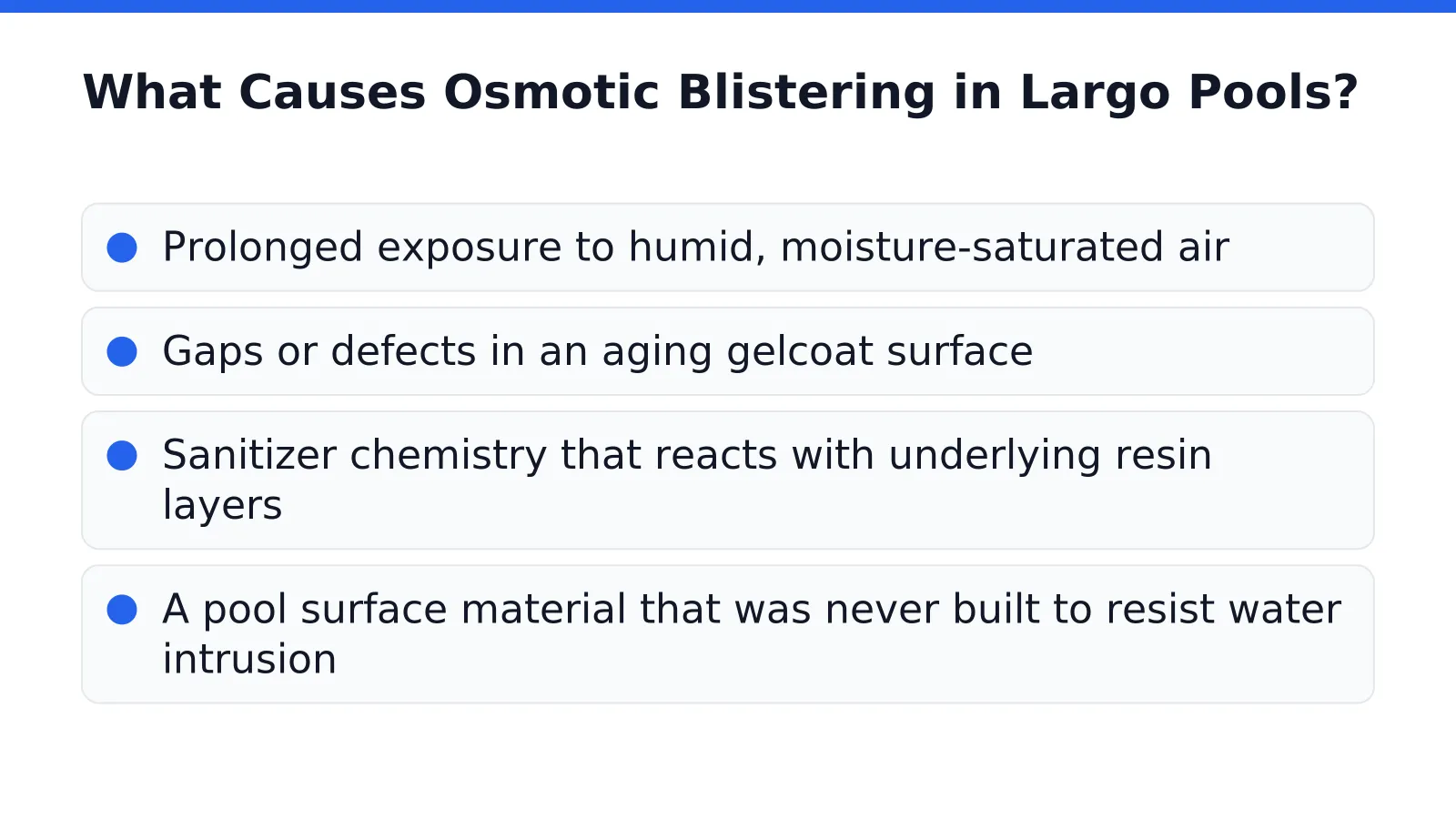
No single factor explains every blister. In most cases, fiberglass pool blistering develops from a combination of conditions rather than one isolated cause. Possible contributing factors include:
Moisture intrusion: water that penetrates the gel coat and becomes trapped against the laminate underneath.
Aging or damaged gel coat: as a gel coat ages or develops small gaps, moisture has an easier path through.
Surface or coating defects: inconsistencies from the original application can leave weak points where blisters are more likely to start.
Improper surface preparation: a surface that wasn’t properly prepared before coating or resurfacing may not bond as well, which can increase the risk of moisture getting underneath.
Poor bonding between layers: when the gel coat, resin, and laminate don’t bond fully, small voids can form and later fill with water.
Water chemistry issues: unbalanced or harsh pool chemistry can, over time, react with the resin and contribute to surface breakdown.
Installation or manufacturing issues: when present, inconsistencies from the original build can make a shell more susceptible to blistering later on.
Long-term exposure to pool water and chemicals: years of contact with water and sanitizers can gradually wear down even a well-applied coating.
Because these factors can combine in different ways, the cause behind one pool’s blistering may look different from another’s, which is why an in-person evaluation is the most reliable way to identify what’s actually happening on a pool’s surface.
How does Florida’s climate factor in?
Florida pools see heavy year-round use, strong UV exposure, frequent chemical treatment, and a mix of rain and warm temperatures that can all contribute to surface wear over time. Humidity is part of the picture, but it’s one factor among several, not the sole cause of gelcoat blistering. Pools in Largo, elsewhere in Pinellas County, and across the greater Tampa Bay area deal with these conditions for most of the year, which is one reason local surface wear can show up differently than it would in a drier or more seasonal climate.
How Serious Are Fiberglass Pool Blisters?
Not every blister points to the same level of concern. The right response depends on how much blistering is present and what else is happening on the surface.
A few isolated surface blisters: often a localized issue that can be addressed with targeted repair.
Widespread blistering: bumps appearing across large sections of the pool suggest the moisture issue may be more extensive than a single spot.
Blisters that return after previous repairs: recurring blistering in the same area can mean the underlying moisture path wasn’t fully addressed the first time.
Blistering combined with cracking, soft spots, delamination, or other visible damage: when blisters show up alongside these additional signs, the surface and laminate underneath may need a closer look.
The proper repair depends on the actual condition of the pool, not on assumptions. An inspection is the most reliable way to tell whether you’re dealing with a surface-level issue or something that calls for more extensive work.
Can Fiberglass Pool Blisters Be Repaired?
Yes, in most cases fiberglass pool blisters can be repaired, and the right method depends on how much of the surface is affected.
Spot repair: suitable for limited or isolated damage, where the compromised gel coat is removed and the area is rebuilt with fresh material and a protective top coat.
Removing damaged material and rebuilding the affected area: for blisters that go deeper than the surface, the compromised material is cut out before new material is applied, so the repair bonds to solid, dry laminate instead of being patched over a weak spot.
Larger resurfacing work: when blistering is widespread, or the existing surface has deteriorated significantly, resurfacing a larger section, or the entire pool, can offer a more even, lasting result than repeated spot repairs.
Full resurfacing isn’t automatically the answer for every blister. Many pools with isolated, minor blistering can be repaired without redoing the whole surface. The scope of the work should match the extent of the damage.
When Is Full Fiberglass Resurfacing the Better Option?
Full resurfacing tends to make more sense when:
Blistering is widespread rather than confined to a small area
Multiple areas of the pool are showing signs of failure
The surface is also faded, rough, cracked, or otherwise deteriorated
Previous spot repairs haven’t held up
The coating or finish is nearing the end of its useful condition
Blistering is widespread rather than confined to a small area
Multiple areas of the pool are showing signs of failure
The surface is also faded, rough, cracked, or otherwise deteriorated
Previous spot repairs haven’t held up
The coating or finish is nearing the end of its useful condition
Even when several of these signs are present, the best way to confirm whether full fiberglass resurfacing is the right call is to have the pool inspected in person. A visual and physical check of the gel coat, laminate, and surrounding areas gives a clearer picture than judging from the appearance of a few blisters alone.
A Different Surface Issue: Cobalting (Black Dot Staining)
Cobalting, sometimes called black dot staining, is a separate surface issue from blistering. It shows up as small, dark spots caused by tiny air pockets sealed into the gel coat during manufacturing, rather than from moisture intrusion over time. Because it comes from the original application process, cobalting is typically present early on rather than developing gradually like osmotic blistering. If you notice dark spotting on your pool’s surface, it’s worth having it evaluated separately from any blistering, since the cause and the repair approach can differ.
How Aquatic Surfaces Approaches Fiberglass Pool Repair
Whatever the scope of the work, from a single blister to a full resurface, the process generally follows the same core steps:
Proper surface preparation: the damaged or compromised gel coat is removed, and the area is cleaned and prepped so new material can bond properly.
Chemical-resistant bonding agents: these help new material adhere securely to the existing laminate, reducing the chance of the same spot failing again.
Fiberglass mat and resin: applied to rebuild the structural layer where material was removed, restoring strength to the affected area.
Protective top coat: the final layer that returns the surface to a smooth, sealed finish and helps protect against future moisture intrusion.
This approach applies whether the job is a small spot repair or a complete resurface. The scale changes, but the underlying method stays consistent.
How Can You Tell If a Blister Needs Professional Attention?
Most homeowners can’t tell from a glance whether a blister is a minor cosmetic issue or something more. A few signs are worth having checked out by a professional:
Multiple or spreading blisters, rather than a single isolated bump
Soft or flexible spots when you press on the surface
Cracking around blistered areas
Peeling or delamination of the surface layer
Blisters returning in the same spot after a previous repair
Widespread surface deterioration, such as fading, roughness, or chalkiness alongside blistering
If you notice any of these, having the pool evaluated is a reasonable next step rather than waiting to see how it progresses.
FAQ
What causes blisters in a fiberglass pool?
Blisters can result from a combination of factors, including moisture intrusion, an aging or damaged gel coat, surface or coating defects, improper surface preparation, water chemistry issues, and long-term exposure to pool water and chemicals. No single factor is responsible for every case.
Are fiberglass pool blisters serious?
It depends on how widespread they are and what else is happening on the surface. A few isolated blisters are often a minor, localized issue, while widespread blistering, recurring blisters, or blistering combined with cracking or soft spots may point to a more significant problem that’s worth having inspected.
Can fiberglass pool blisters be repaired?
Yes. Depending on the extent of the damage, repair options range from spot repair of isolated blisters to removing and rebuilding an affected area, up to larger resurfacing work when blistering is widespread.
Does one blister mean the whole pool needs resurfacing?
Not necessarily. A single or isolated blister can often be addressed with a targeted spot repair. Full resurfacing tends to make more sense when blistering is widespread, recurring, or paired with other surface damage.
Can poor water chemistry contribute to blistering?
Yes, unbalanced or harsh pool chemistry can react with the resin beneath the gel coat over time and may increase the risk of blistering, though it’s typically one contributing factor among several rather than the sole cause.
When should a fiberglass pool be resurfaced instead of patched?
Resurfacing is generally worth considering when blistering is widespread, previous spot repairs haven’t held, or the surface shows additional wear such as fading, roughness, or cracking. An in-person inspection is the best way to confirm which approach fits the pool’s actual condition.
Conclusion
Fiberglass pool blisters can range from a minor surface issue to a sign of a more extensive coating or laminate problem, depending on how widespread they are and what else is happening on the surface. Understanding the possible causes, from moisture intrusion and gel coat aging to water chemistry and general wear, helps you make sense of what you’re seeing rather than guess at it. The right repair, whether a small spot repair or a full resurface, depends on the pool’s actual condition, which is best confirmed through an in-person inspection.
If you’re noticing blistering, bubbling, or other fiberglass surface damage on your pool in Largo, Pinellas County, Tampa Bay, or elsewhere in Florida, Aquatic Surfaces FL can evaluate your pool’s surface and walk you through the repair options that fit its condition. Call +1 (727) 755-7283 to schedule a professional evaluation.